

The Washington Accords and the Future of Economic Transformation in the Great Lakes Region
How the December 4, 2025 Peace Agreement Unlocks Strategic Opportunity for the Democratic Republic of The Congo and Global Trade Management Consulting & Staffing (GTMCS)
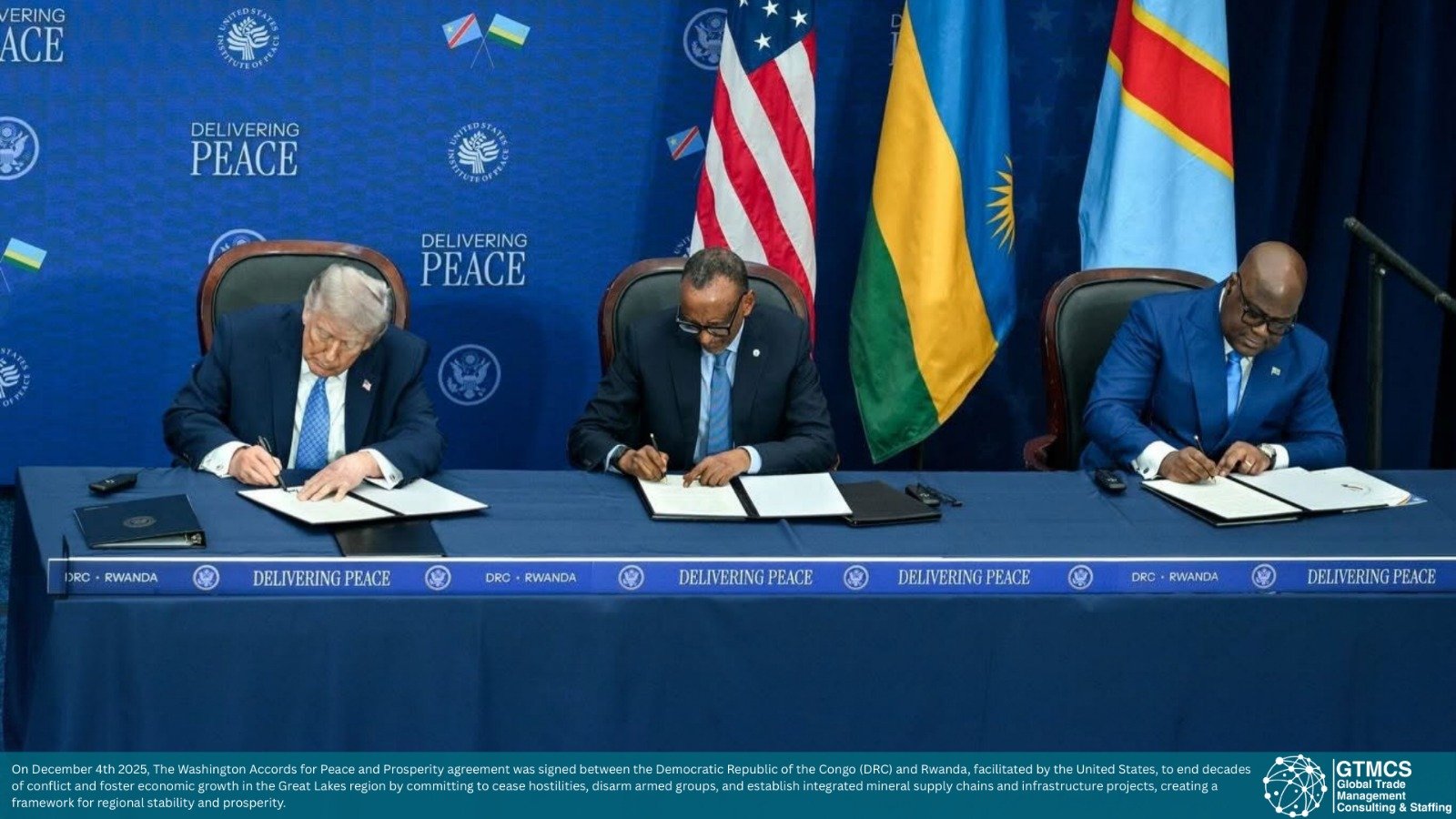
On December 4, 2025, a historic milestone was reached when the Washington Accords for
Peace and Prosperity were signed between the Democratic Republic of the Congo and the
Republic of Rwanda in Washington, D.C. Hosted by Donald J. Trump and signed by Felix
Tshisekedi and Paul Kagame, the agreement represents a decisive shift from decades of
instability toward structured regional integration and economic cooperation.
This agreement reinforces the Peace Agreement initially signed on June 27, 2025, and formally
advances the Regional Economic Integration Framework (REIF), establishing a comprehensive
roadmap for energy development, mineral supply chain reform, infrastructure expansion, and
cross-border economic collaboration.
Beyond its diplomatic significance, the Washington Accords redefine the economic architecture
of the Great Lakes region and create transformative opportunities for strategic investors,
institutions, and workforce development partners—including Global Trade Management
Consulting & Staffing (GTMCS)
From Conflict to Coordinated Economic Integration
For decades, instability in eastern DRC was driven by illicit mineral trade, fragmented border
governance, weak regulatory harmonization, and the financing of armed groups through
untraceable mineral flows. The June 2025 Peace Agreement addressed security and
sovereignty concerns; the December 4 Washington Accords operationalize those commitments
through economic structure.
The REIF establishes formal coordination mechanisms between the two governments in five
strategic sectors:
● Energy generation and transmission
● Mineral supply chain transparency and traceability
● Infrastructure and logistics connectivity
● National park management and tourism
● Public health coordination
The framework emphasizes sovereignty, transparency, formalization of artisanal mining, tax
harmonization to prevent smuggling, and alignment with international due diligence standards
such as the OECD and ICGLR mechanisms.
Simultaneously, the DRC and the United States signed a Strategic Partnership Agreement,
reinforcing long-term cooperation in critical minerals, infrastructure, governance reform, and
industrialization.
Together, these instruments create a multi-layered governance and investment platform
designed to transform peace into measurable economic progress
How the Democratic Republic of the Congo Benefits
1. Stabilization and Formalization of the Mineral Sector
The DRC gains structured mechanisms to:
● Eliminate illicit mineral flows
● Enhance traceability and certification systems
● Harmonize mining-related tax regimes
● Strengthen inspection and regulatory oversight
● Formalize artisanal and small-scale mining (ASM)
These reforms increase state revenue capture, improve global investor confidence, and elevate
labor and safety standards.
2. Enhanced Foreign Direct Investment Climate
The U.S.–DRC Strategic Partnership includes commitments to:
● Improve regulatory predictability
● Introduce fiscal stabilization mechanisms
● Streamline VAT reimbursement systems
● Establish centralized tax coordination structures
● Promote transparent governance oversight through a Joint Steering Committee
These measures significantly reduce investor risk and improve the DRC’s global
competitiveness.
3. Infrastructure and Corridor Development
The Sakania–Lobito Corridor is identified as a strategic export artery connecting the DRC to the
Atlantic Ocean. Within five years, significant volumes of copper, cobalt, and zinc are projected to
transit this route.
This development:
● Diversifies export logistics
● Reduces transport bottlenecks
● Strengthens trade integration
● Generates employment in logistics and infrastructure sectors
4. Energy Expansion as an Industrial Catalyst
Under the REIF, energy cooperation includes:
● Ruzizi III hydropower development
● Coordinated methane gas exploitation from Lake Kivu
● Expanded cross-border electricity transmission
Reliable energy supply is foundational to mining beneficiation, industrial transformation, and
national electrification.
Strategic Implications for Global Trade Management Consulting & Staffing (GTMCS)
Global Trade Management Consulting & Staffing is strategically positioned at the intersection of
workforce modernization, regulatory reform, and international investment facilitation.
The Peace Agreement creates structural demand across all four pillars of Global Trade
Management Consulting & Staffing (GTMCS) services.
Strategic and Sectoral Consulting
The implementation of REIF and the Strategic Partnership generates demand for:
● Mining sector regulatory advisory
● ESG compliance consulting
● Cross-border policy harmonization support
● Infrastructure feasibility analysis
● Energy and corridor workforce planning
● Investor–government facilitation
As outlined in the Global Trade Management Consulting & Staffing (GTMCS) Blue Ocean
Strategy framework, the firm’s integrated model—combining consulting, staffing, compliance,
and training—creates an uncontested market space in workforce advisory excellence.
Rather than operating as a transactional recruitment firm, Global Trade Management Consulting
& Staffing (GTMCS) functions as a strategic workforce systems partner aligned with national
development goals.
Staffing & Recruitment
The post-peace investment environment will require:
● Mining engineers
● Environmental and ESG auditors
● Supply chain specialists
● Infrastructure project managers
● Energy sector technicians
● Financial compliance officers
● ICT and digital trade professionals
The REIF’s emphasis on formalization and traceability further elevates the importance of
professionally trained, compliance-ready talent pools.
GTMCS’ diaspora talent mobilization model directly aligns with these needs, connecting
international Congolese expertise with domestic industrial expansion initiatives.
Continuous Training & Talent Development
The agreements prioritize workforce professionalization and alternative livelihood programs for
ASM communities.
GTMCS can operationalize this mandate through:
● Bilingual (English–French) certification programs
● Mining safety and compliance academies
● Logistics and corridor workforce development programs
● Executive leadership development for public institutions
● Digital upskilling platforms aligned with traceability systems
This supports both investor expectations and national human capital advancement.
Full-Service HR Solutions
As multinational firms expand operations, demand will increase for:
● Legally compliant employment contracts
● Payroll and benefits administration
● Labor law advisory
● Workforce onboarding systems
● ESG-aligned HR monitoring
● Performance management frameworks
The enhanced governance structures embedded within the Strategic Partnership Agreement
elevate HR compliance standards across the mining and infrastructure sectors.
Global Trade Management Consulting & Staffing (GTMCS)’ full-service HR model ensures
workforce integrity, transparency, and operational efficiency in this evolving regulatory
environment.
A Defining Moment for the Great Lakes Region
The December 4, 2025 Washington Accords signal a structural transformation in the economic
trajectory of the Democratic Republic of the Congo and the broader Great Lakes region.
Through coordinated mineral governance, energy integration, infrastructure modernization, and
institutional reform, the DRC is repositioning itself as a strategic partner in global critical mineral
supply chains rather than a high-risk extraction environment.
Peace, when institutionalized through transparent economic frameworks, generates sustainable
opportunity.
For GTMCS, this new environment strengthens its strategic mandate:
● To advise investors and institutions through regulatory transformation
● To mobilize diaspora and local talent into structured industrial growth
● To deliver compliant, ESG-aligned workforce solutions
● To serve as a bridge between international standards and national development
The Washington Accords do not merely end a chapter of conflict. They open a new era of
coordinated prosperity—one in which strategic workforce systems will be central to the DRC’s
long-term economic success.